Impromptu Speech Topics
120 no-research topics sorted by category below. Or draw one at random, try a 60-second answer and get feedback.
296 topics available · up to 1 per draw.
Speech
296 topics available · showing up to 1 · no repeats until this pool is used.
Instant picks from our topic collection. Broaden your filters for more options.
Your next step · Free speech feedback
Make your next answer clearer.
Practice this topic. Get one clear suggestion, try it once, and compare your two answers.
Example feedback · illustrative
“A short walk helps me feel better.”
A 20-second change: Name one walk and what changed afterward. Re-record just that example and compare.
Two free attempts — speak or type — including retries. No sign-up or card. Feedback on your words and structure.
⏱️Speech Timer
🧑🏫 For teachers · classroom pack
Speech & Impromptu Topics Pack
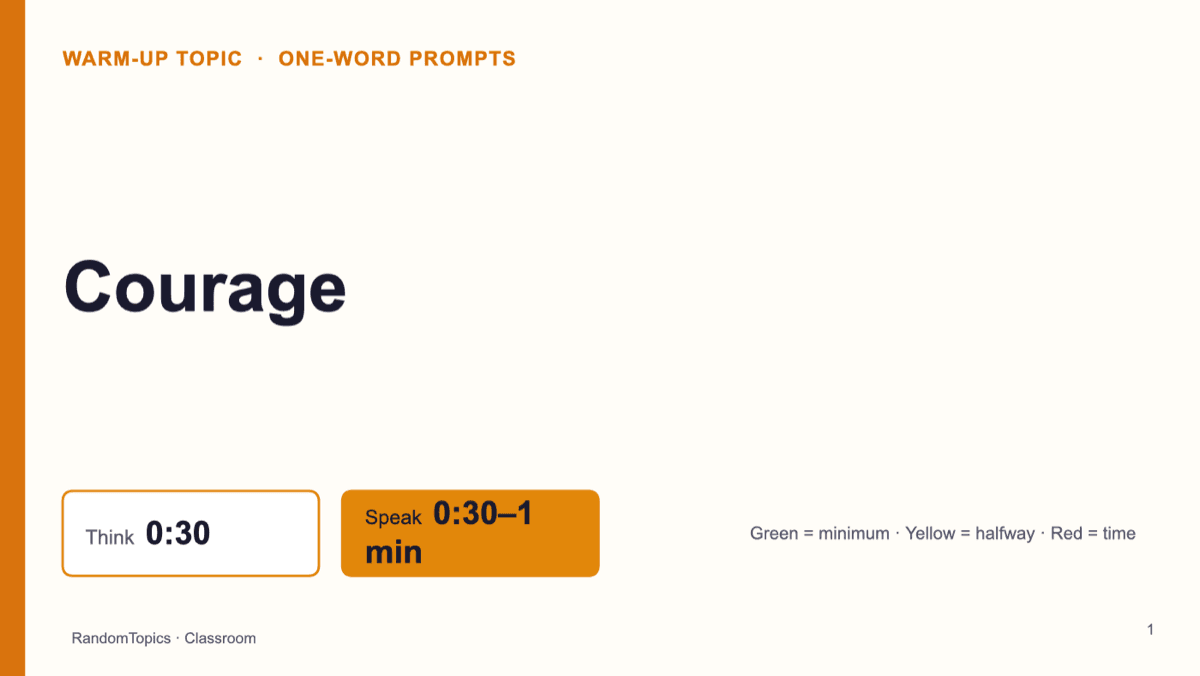
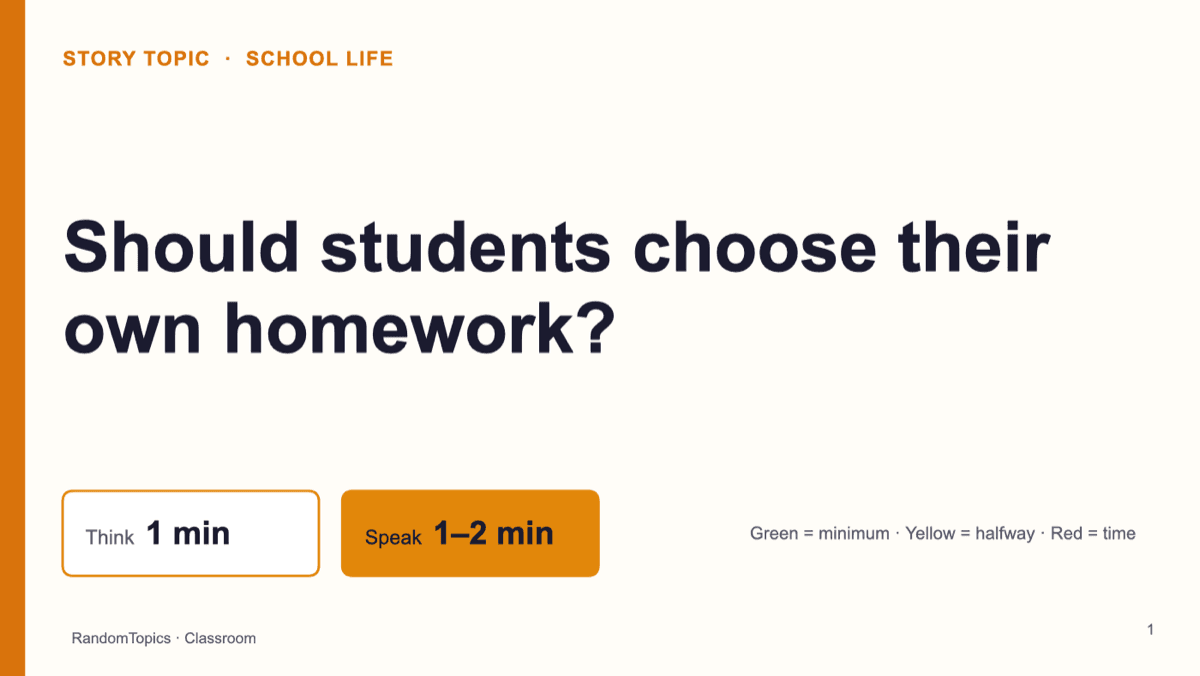
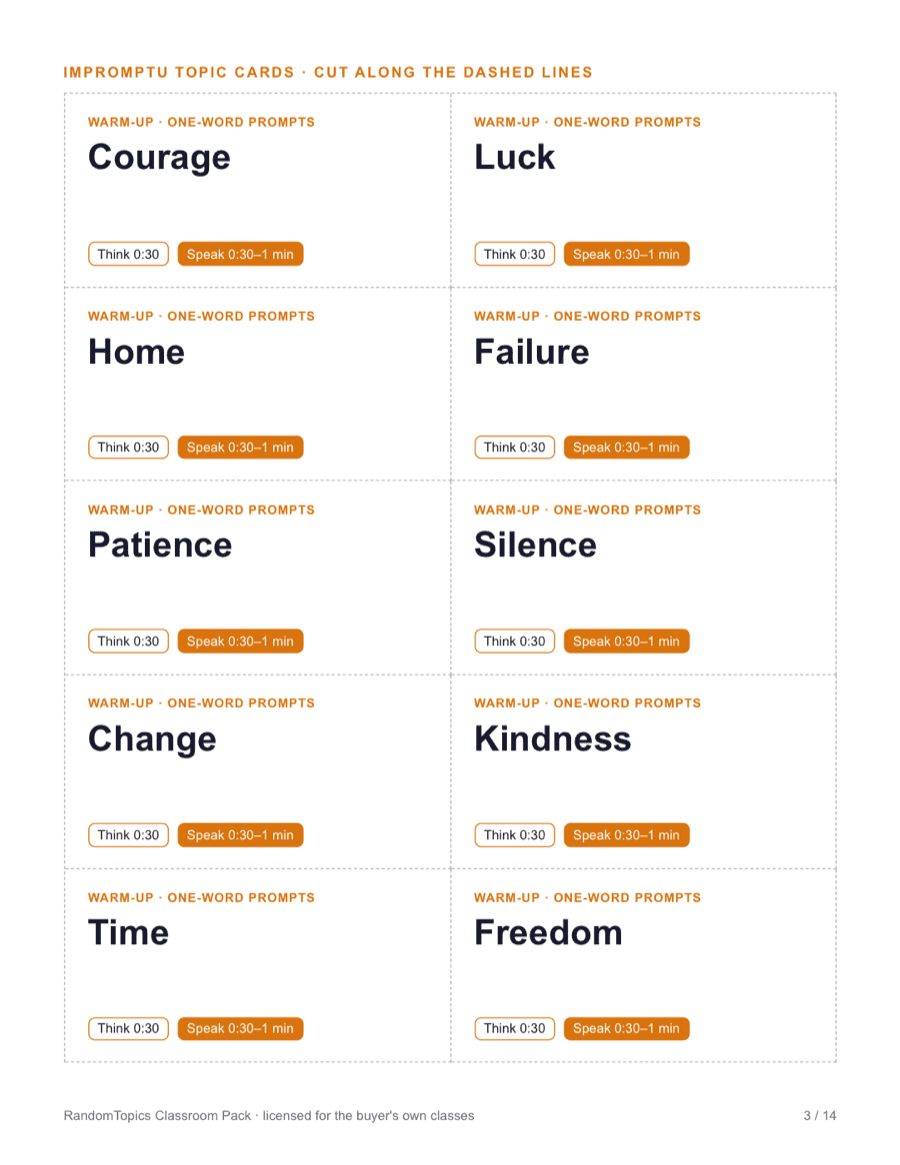
102 impromptu speech topics from warm-ups to arguments, each with a think-and-speak timing rule.
- ✓ Editable PPTX (opens in Google Slides)
- ✓ Printable PDF
- ✓ Ad-free full-screen presenter
One-time payment · no subscription · instant PPTX + PDF download · ad-free presenter mode. All packs includes every pack we add later.
See every classroom pack and the FAQ · Try the presenter with 5 free slides · Already bought? Your downloads
120 Impromptu Speech Topics by Category
Every topic works without research: answer from your own experience or opinion. Start with personal experiences if you are new, and move to quotes and one-word prompts for harder rounds.
Personal experiences
Easiest for beginners: everyone already has the story.
- The best piece of advice I ever ignored
- A time I changed my mind
- My most useful mistake
- A small habit that improved my life
- The best day of my last year
- Someone who taught me something without trying
- A skill I learned the hard way
- The place I feel most like myself
- A tradition my family keeps
- The first thing I bought with my own money
- A moment I was proud of someone else
- Something I believed as a kid that turned out to be wrong
- The hardest goodbye I've said
- A risk I'm glad I took
- What my phone says about me
Everyday opinions
Pick a side in the first sentence, then defend it with one example.
- Is it better to be early or exactly on time?
- Should everyone learn to cook?
- Are group projects worth it?
- Mornings or nights: which is more productive?
- Is it rude to wear headphones in public?
- Should you tell a friend their idea is bad?
- Is boredom good for you?
- Paper books or e-books?
- Should tipping be replaced by higher wages?
- Is it better to be a big fish in a small pond?
- Are video games a waste of time?
- Should everyone have a side hustle?
- Is it okay to quit something you started?
- Cats or dogs: which makes the better roommate?
- Is social media better for keeping in touch or worse?
Hypotheticals
Fun for clubs and classrooms; state your choice, then your reason.
- If you could add one subject to every school, what would it be?
- If you had to live in one decade forever, which one?
- If you could master any instrument overnight, which and why?
- If you ran your town for a day, what would you change first?
- If you could have dinner with any fictional character
- If money weren't an issue, what job would you do?
- If you could delete one invention from history
- If animals could vote, which one would win an election?
- If you had to teach a class tomorrow, what would it be on?
- If you could live in any book or movie world
- If you could make one rule everyone had to follow
- If you woke up with one superpower you didn't want
- If you could send one message to yourself ten years ago
- If you could only eat one cuisine for a year
- If you were famous for one thing, what would it be?
One-word prompts
Classic Table Topics and forensics drill: define the word your way, then tell a story about it.
- Courage
- Luck
- Home
- Failure
- Patience
- Silence
- Change
- Kindness
- Time
- Freedom
- Curiosity
- Balance
- Trust
- Ambition
- Gratitude
Quotes and proverbs
Agree or disagree with the saying and give one real example.
- “The early bird catches the worm.”
- “Actions speak louder than words.”
- “Don't judge a book by its cover.”
- “Practice makes perfect.”
- “Honesty is the best policy.”
- “The grass is always greener on the other side.”
- “You can't please everyone.”
- “Where there's a will, there's a way.”
- “Less is more.”
- “Two heads are better than one.”
- “It's never too late to learn.”
- “Curiosity killed the cat.”
- “Rome wasn't built in a day.”
- “Fortune favors the bold.”
- “Laughter is the best medicine.”
Funny and light
Good warm-ups: aim for one laugh and a clear ending.
- Why pineapple belongs on pizza (or never does)
- The worst superpower to have
- A tour of the junk drawer in my kitchen
- Convince us your favorite snack should be the national snack
- Why socks disappear in the laundry
- The most overrated holiday
- How to survive a family group chat
- Explain your favorite app to someone from 1900
- The perfect excuse for being late
- Why naps should be mandatory
- Pitch a new holiday
- The strangest food combination I enjoy
- Rules for sharing a pizza
- Why my pet would be a terrible roommate
- The best and worst sound in the world
For students
Ages 10 and up; works for speech class and morning meetings.
- The best class I've ever taken
- Should students choose their own homework?
- What makes a great teacher?
- The perfect school lunch
- Should school start later in the morning?
- A book everyone my age should read
- The most useful thing I learned outside school
- Should phones be allowed in class?
- What I'd do with an extra hour every day
- The best field trip idea
- Uniforms: yes or no?
- My dream after-school club
- The hardest part of being a student
- What I want to be famous for
- Is it better to study alone or with friends?
Work and interview practice
Answer like an interview: situation, what you did, what happened.
- Tell us about a time you solved a problem quickly
- The best manager or coach you've had
- How you handle a deadline you can't meet
- A project you'd do again differently
- What makes a meeting worth attending?
- Remote work or the office?
- A piece of feedback that changed how you work
- How you'd explain your job to a child
- The most useful tool in your day
- How you recharge after a hard week
- Describe a time you disagreed with your team
- What you look for in a good colleague
- One skill you're working on this year
- The best career advice you've received
- Why you'd hire yourself
Preparing a researched talk instead of speaking on the spot? Use the speech topic generator for persuasive, informative and presentation topics, or practise listening and speaking in turns with these group discussion topics.
More versions: impromptu speech topics for students, funny impromptu speech topics and 1 minute speech topics.
How to Practice Impromptu Speaking
Impromptu speaking feels like a talent, but it's a trainable skill with a simple formula: reps under time pressure. Reading tips doesn't make you better — speaking does. Pick a topic from the list above (or draw one at random), start the practice timer, give yourself 15-30 seconds to think, then speak until the timer ends.
Impromptu formats show up everywhere: speech class assignments, NSDA and forensics Limited Prep events, Toastmasters Table Topics, MUN crisis responses, and the classic interview curveball ("Tell me about a time..."). The common thread: a structure you can deploy in seconds and calm delivery while your brain catches up.
The 30-Second Prep Routine
- Seconds 0-10 — Pick your point. Decide the one sentence you'd say if you could only say one. That's your opening and your closing.
- Seconds 10-25 — Pick two supports. A reason and a story, or two examples. Don't outline more than two — depth beats breadth in short speeches.
- Seconds 25-30 — Plant your first sentence. Knowing exactly how you'll start eliminates the most dangerous silence: the first one.
Weekly Practice Plan (15 Minutes a Day)
- Mon/Wed/Fri: 4 topics × 2-minute speeches with 30-second prep. Record one and count filler words.
- Tue/Thu: 2 topics × 5-minute speeches with 2-minute prep — build endurance and deeper structure.
- Weekend: one "cold start" — speak the instant you read the topic, zero prep. This is the hardest and highest-yield drill.
Want a ready question bank to drill from? Work through our 120 Table Topics questions — classic, funny, work, and family prompts you can practice one after another.
Preparing a full presentation instead? Browse our speech topic generator for prepared speech ideas, practice a complete timed talk with the five-minute speech topics and timer, or grab ready-made lists like presentation ideas for school.
Frequently Asked Questions
What is an impromptu speech?
An impromptu speech is delivered with little or no preparation — you receive a topic and speak within seconds or minutes. It's a standard event in speech class, competitive forensics (Limited Prep events), Toastmasters Table Topics, and many job interviews.
How long is an impromptu speech?
Common formats: 1-2 minutes for Toastmasters Table Topics, 3-5 minutes for classroom impromptu, and 5-7 minutes (with up to 2 minutes prep) for NSDA competitive impromptu. Our built-in timer covers all of these presets.
What are good impromptu speech topics?
The best impromptu topics are ones anyone can speak about without research: personal experiences, opinions on everyday questions, abstract words (courage, failure, luck), proverbs, and light hypotheticals. The list on this page groups 120 of them by type, from beginner-friendly personal stories to harder one-word prompts.
How do I structure an impromptu speech quickly?
Use PREP: Point (state your answer), Reason (why you believe it), Example (a short story or fact), Point (restate to close). With 30 seconds of thinking time, decide your Point and your Example — the rest fills itself in as you speak.
Are these impromptu speech topics free to use?
Yes — the full list, the random picker with category and depth filters, and the practice timer are free with no signup. Teachers can use the topics in class. Optional AI feedback includes two free attempts (spoken or typed), including retries; more recorded practice is available on the monthly plan.